The meeting was lively. President Tricia Bunten gave us a lesson on Minnesota history when on this day in 1960 the Washington Senators became the Minnesota Twins. There was a reasonable rendition of America the Beautiful with Past President John Baumgarten at the piano adjusting both the key and the tempo to make us sound good. Beth Storaasli stated real wealth is good health. And she made the case that service above self is a healthy life style. She asked why not volunteer when it is both fun and healthy.
The program, and this article, became shorter when, for the first time in living memory, there was no Fellowship Report. Tricia Bunten stepped in to pitch hit and recognized our visiting Rotarians and numerous guests. It is hard to say how many Rotarians had their work zone fines ready. What can be said is that the Golden Can was short changed. But from crisis comes opportunity. Rotarians young and old, excuse me: new and seasoned, have the opportunity for better health and longer life by volunteering for Club Service as a Fellowship Reporter.
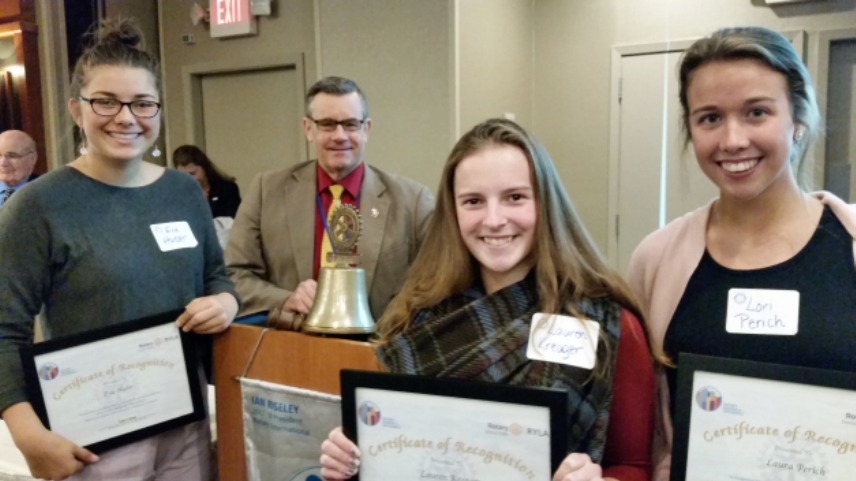
RYLA participants Eva Huber, Lauren Kreager and Lori Perich with Chair of the New Generations Committee Rob Hofmann
Rob Hofmann had the agreeable duty of introducing three young women who attended the RYLA leadership camp last summer. RYLA (Rotary Youth Leadership Award) is a weeklong leadership training program sponsored by Rotary District 5580 and held in Crookston, Minnesota. In collaboration with the other Rotary Clubs in Duluth (ECO, Skyline, Harbortown), 18 young people from our area were sent to camp. The funds to send our students were provided by your Rotary Club of Duluth Foundation. Three of the four students were present to thank Rotary for their personal growth and life-changing experience.
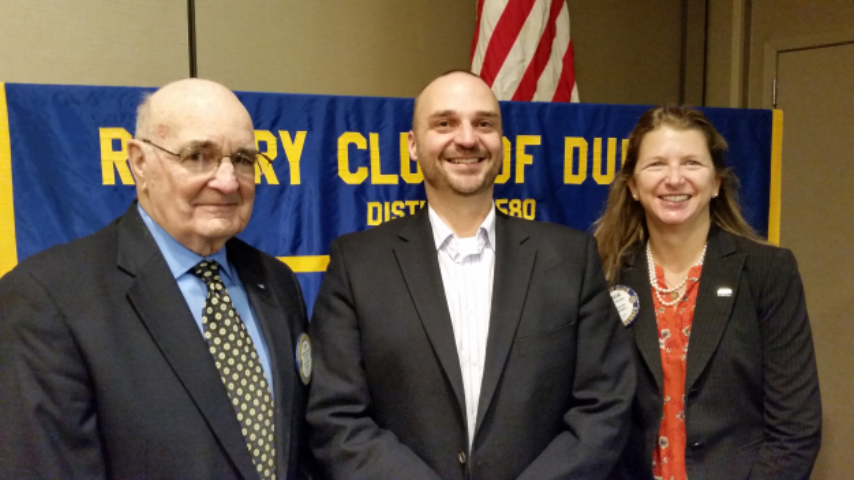
Chair of the Day Dick Carlson, Speaker Jay McLaren and President Tricia Bunten
Past President and Chair of the Day Dick Carlson introduced Jay McLaren, Vice President of Public Policy and Government Relations at MEDICA. The program represented Part Two of the Health Care debate. Last week at Rotary, there was a discussion on the single payer government option. Today’s discussion was from the private sector insurance point of view. Mr. McLaren framed it as a conversation about what people want from the health care system.
A key element of his presentation was the interlocked concepts of quality, cost, and speed. As much as people would want there to be an overlap of all three, the practical on-the-ground evidence is that in a product delivery system, you only get to have two of three at the same time. An example would be the desire to have high quality and timely delivery of health services. To accomplish these two, affordability is sacrificed. Should society seek a combination of high quality and affordability, the result is “less than timely delivery”. These outcomes are consistent with a well understood theory of delivery systems not unique to healthcare.
The presentation of detailed information and comparison between the United States and nations with single payer (government) or hybrid systems provided a picture of how complex these economic and health care decisions are. There was also an education on the process of polling. The answers to a question can change dramatically when there is a related follow up question. One example is to what extent people would support a single payer government system. The initial answer is yes. When asked the follow up question about support for increased general taxes to pay for the program, the poll results are dramatically less favorable. This information was provided to help explain why there is not more political will to address deficiencies.
Prepared remarks were relatively short. The intent was to set the stage for questions. And there was no shortage of tough, on target, questions. Was the wait time data in Canada influenced by the Province in which you lived? What is the effect when government controls both payment and provision of services? Why has the increased spending in the US (as a percentage of GDP) not generated more improvement in outcomes? Would insurance be more affordable if we could purchase insurance across state lines? Has the cost of medical school created a barrier of entry for physicians creating a shortage of doctors and driving up cost? Has the hidden cost to employers to obtain and manage health care insurance for their employees been factored into the discussion about the benefits of changes to the system?
The speaker took on each of these questions and more. The answers were often complex. Time did not permit the level of detail sought by those asking the questions. Clearly, we as a nation need to decide which of the two out of three (quality, cost, speed) components are of the greatest value and design our healthcare system accordingly.




.jpg)