|
President Elaine Hansen opened our meeting. Inspired by a gloriously sunny day, we began our meeting singing the “America the Beautiful” accompanied by Past President John Baumgarten. Past President Dick Carlson followed with an inspiring invocation that included reminiscences of his years at UMD from 1946 to 1950. During this time he witnessed the evolution of what was Duluth State Teachers’ College to the University of Minnesota Duluth campus. He also saw the school colors change from Green and Gold to the now familiar Maroon and Gold. Traci Marciniak, this week’s Fellowship Reporter, welcomed a number of guests of Rotarians. Bruce Anderson brought his “future son-in-law” Marius Wissenhauser. President-Elect Tricia Bunten was unable to join us this afternoon, yet was able to host UMD guests Steve Keto and Fernando DelGato. Amy Galbraith brought fellow UMD Community Ed colleague Roxanne Richards. Geiger Yount hosted Sara Rolfson from Zeitgeist Center for Arts and Community. President Elaine Hansen brought Molly Harney of UMD. Tony Sega played host to Nick Alworth. Pat Pfahl was caught on the “kiss-cam” at Amsoil Arena smooching his wife Susan during last Friday’s UMD playoff hockey game. Bill Gronseth was fined in absentia for an article, in the Duluth News Tribune, on the Duluth Preservation Alliance listing Old Central High School as one of Duluth’s 10 most historic properties. Jim and Dick Olson were called upon again to “kick the Golden Can” for Trevor Olson, who had five goals this season and for scoring his THIRD game-winning goal in the last four games to lift the UND Fighting Hawks to a 6-5 victory over Saint Cloud State in sudden-death. The victory sends the Fighting Hawks to the Final Faceoff in Minneapolis next weekend and closer to defending their 2016 Frozen Four title. They will face Denver on Friday. Dave Holappa called forth all Finns to “Kick the Golden Can” to celebrate St. Urho’s Day – March 16th.. Ryan Johnson encouraged all to attend the Prime Rib Dinner & Auction scheduled for April 20th at Marshall School. Ryan recognized Skeeter Moore and John Foucault for their extraordinary efforts to get the word out to area Rotarians. Ryan also mentioned the 2017 Rotary Trip Raffle will be rolled out very soon – more to come from Ryan and his committee at future meetings. President Elaine reminded us that we are looking for exciting programs to fill our forth quarter meetings. The Program Committee will meet at Noon on Monday, March 27th at the Kitchi Gammi Club. All are encouraged to attend and can register on the website to reserve a spot. Elaine also alerted us to the needs of the Rotary Office in its move to the Holiday Center. Bri needs storage and/or filing cabinets for the office. We are also in need of a table and chairs for the meeting space. If you have any of these items, please contact Bri. Chair of the Day President Elaine Hansen ably substituted for President-Elect Tricia Bunten and introduced our guest speaker UMD Chancellor Lendley “Lynn” Black. Chancellor Black addressed “UMD Challenges in context with National Trends: How states across the country are attempting to control costs and hold the line on college tuition”. To illustrate this point, Chancellor Black demonstrated how costs of attending UMD have changed dramatically from 1970 until now. In 1970, resident undergraduate tuition at UMD was $399 for the academic year. Today it is $11,896 for the academic year. A primary reason for the tuition increase is because state funding across the country has decreased and the cost burden has shifted from state governments and from federal programs, to the students and their universities.
In 1969-1970, the University of Minnesota system received state appropriated funds of $66.9 million. The total State of Minnesota general fund appropriation in 1969-1970 was $980 million. That means, the U of M system received 6.82% of the state’s general fund appropriation.
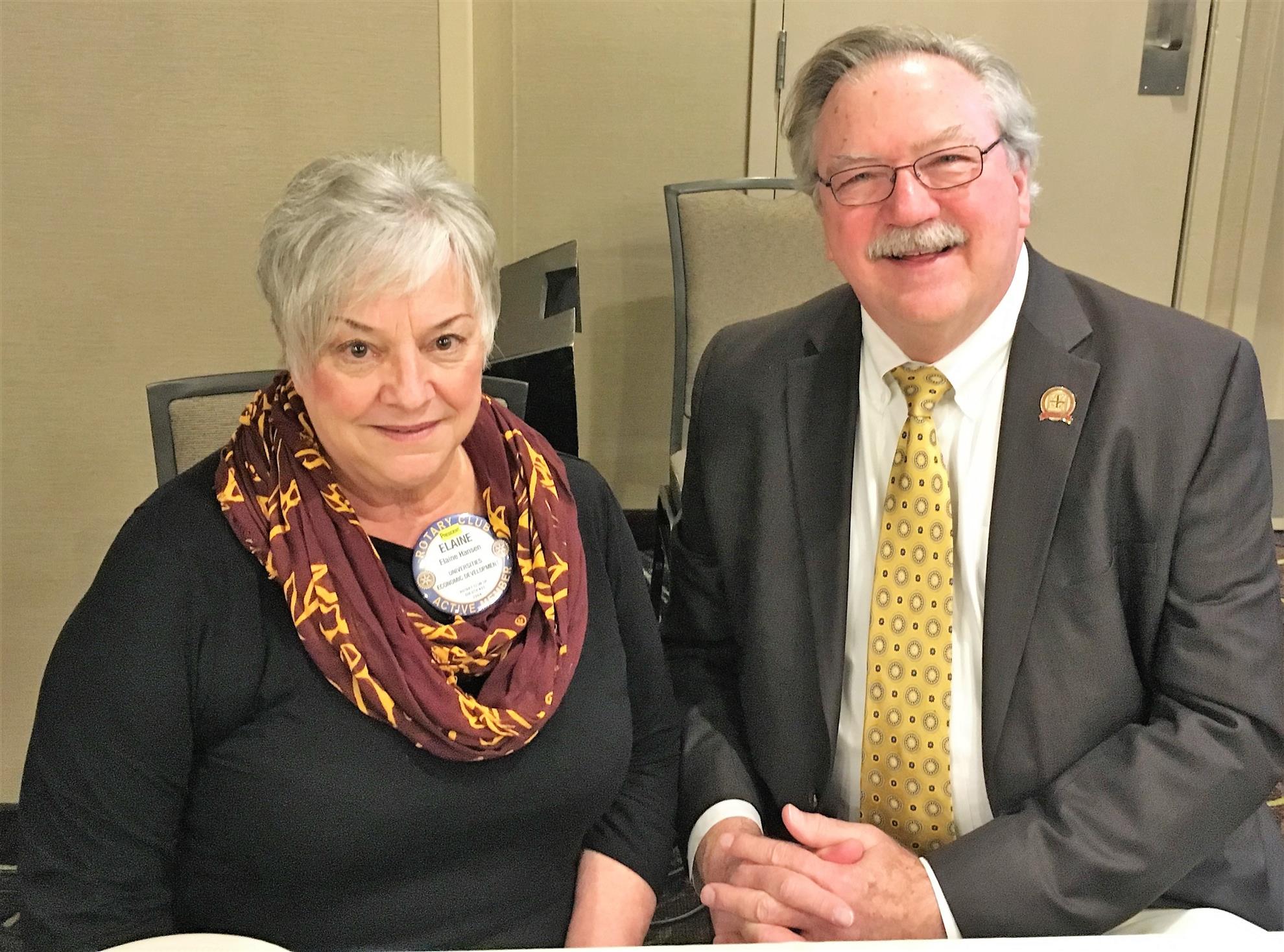
In 2016-2017, the total State of Minnesota’s general fund appropriation was $21.4 billion. Of that, the U of M system received $650 million, meaning that the U of M system received only 3.3% of the state’s general fund appropriation. This clearly demonstrates a shift in higher education funds from tax dollars to student paid tuition. Major reasons for this shift are increasing demands on state budgets, especially from health care, public K-12 schools, and transportation infrastructure needs. To pay for tuition, university students increasingly rely on working several jobs, loans, federal Pell Grants, help from their families, and scholarships. Although working while attending college is a good thing if students are working a reasonable number of hours, working too much detracts from schoolwork, and decreases a student’s ability to take part in an internship, join a club or an association, or volunteer in the community. These kind of activities help students gain valuable leadership skills and build their resumes. Other areas that are rapidly changing in higher education are the increasing need to address social issues. These include serving a more diverse student population that is grappling with issues of drug and alcohol abuse, sexual assault and mental health. Providing these services is another reason that tuition costs have increased. Regardless of these challenges, UMD prepares its students very well. UMD employment rates for graduates are very high. Last year, UMD Career Services released its survey of the Class of 2014–15. Of the 90% of graduates that responded to the survey, 97% reported that they were employed or continuing their education. Partnership is becoming increasingly important to colleges and universities. One example Chancellor Black shared was the Retail Marketing Analytics program in the Labovitz School of Business and Economics. This program was created because businesses told UMD that they could not find enough qualified candidates in the U.S. Last year, the entire class in its Retail Marketing Analytics program had jobs lined up before they had even graduated. President Elaine Hansen and Chancellor Black
|




.jpg)